



Sergey29.07.2026
A very good hotel. The restaurant is superb — look no further. Try the borscht; words cannot do it justice. The venison is outstanding. 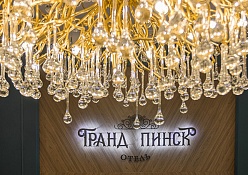




The history of our building
You have come to the right place. “Dobry dzień! Zdravstvuyte! Dzień dobry! Shalom!” — perhaps this is how guests were greeted in this house at different times. Our building has its own history and secrets, closely entwined with the stories of the country, Pinsk and the street on which it stands. It is the story of those who owned the house and those who simply called it home.Grand Pinsk is a landmark of 19th-century architecture in Pinsk. It has witnessed the extraordinary history of this city in the heart of Europe, from the aristocratic splendour of imperial Russia and the austerity of the Soviet period to a contemporary architectural renaissance. The building reflects the cultures of four peoples who have historically lived alongside one another in Pinsk: Belarusians, Russians, Poles and Jews.
The building stands in the heart of Pinsk’s historic centre, on one of its oldest and best-preserved streets. Its architecture and atmosphere take visitors back a century or two. With a little imagination, the journey can extend to some 600 years — roughly the age of the street, which has had at least nine or ten different names. It was once one of only five paved streets in the city, and the only one to have pavements as well as a paved roadway.
When setting out for a walk along what was then Kościuszko Street, local residents would say, ‘Let’s go shpatsering along the Gaz.’ The expression blended Polish and Jewish vocabulary: ‘Gaz’ referred to the main, broad street, while ‘shpatsering’ meant strolling. A related word survives in colloquial Belarusian: ‘shpatsyr’ means a walk on foot.
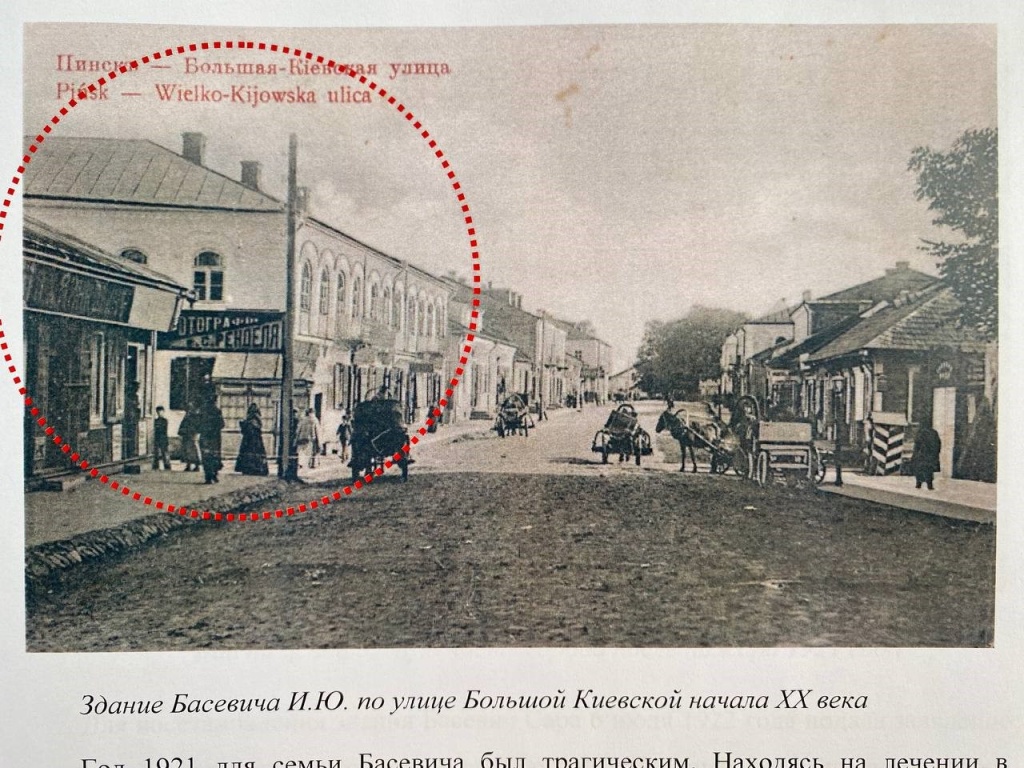
The first recorded mention of the property dates to 1899, when Dvosya Aronovna Zaykgeym mortgaged her land and its stone house, wooden wing, stone storehouse and wooden stable to obtain a loan from the Vilnius Land Bank. After her death, her heirs sold the property on Bolshaya Kievskaya Street, now Lenina Street, to Iosel Yudelevich Basevich in 1907.
The Basevich residence was a two-storey brick building with two further two-storey brick wings facing the courtyard. The owner’s family lived here. Rooms on the ground floor were let to tenants, while the first floor housed a hotel with 12 guest rooms.
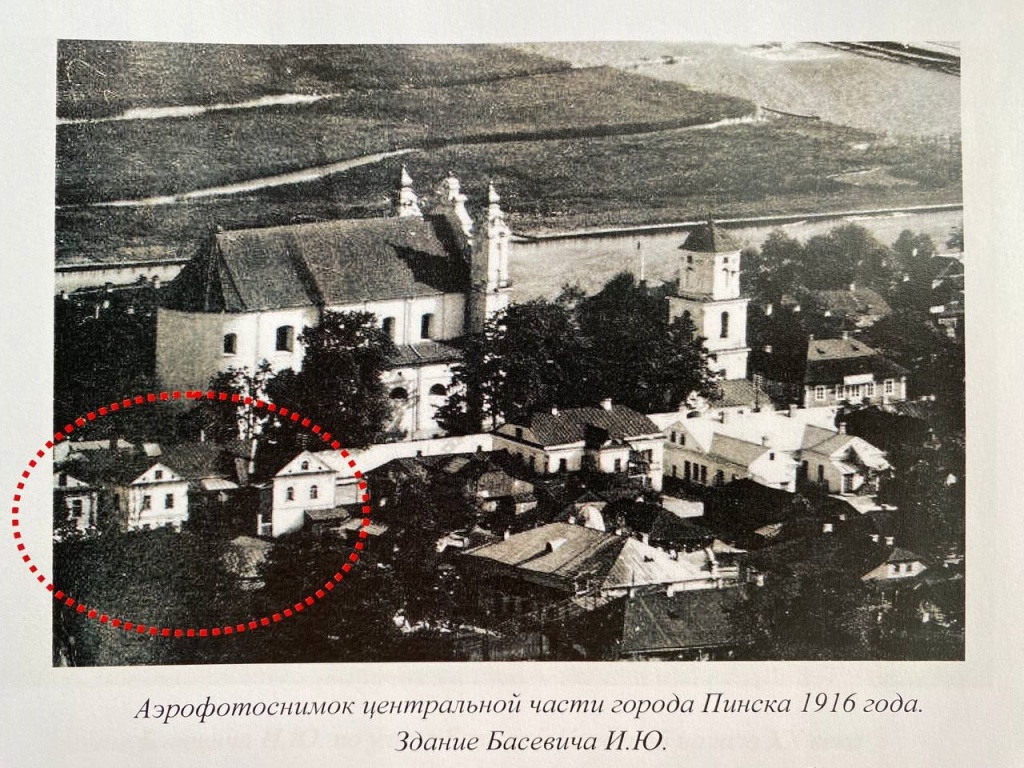
As the first wounded soldiers arrived from the front, premises were set aside for their treatment. Basevich’s hotel was converted into a temporary hospital.
The year 1921 brought tragedy to the Basevich family. On 7 August, a fire centred on Pinsk’s historic district destroyed a third of the city.
Only partly ruined walls remained of the family’s brick buildings; the wooden structures were completely destroyed.
By 1926, the main building and its outbuildings had been fully restored. Alongside the residence stood a brick storehouse, a brick building used to produce carbonated water, a wooden shed, an icehouse, a well and a lavatory.
In 1935, the upper floor was leased to a museum. By 1939, its collection contained 7,760 items, and its library held 736 books. That year, museum staff also provided theoretical and practical support for the World's Fair in New York.
Following the establishment of Soviet rule, the property belonging to Iosel Basevich’s heirs was nationalised in 1940 and transferred to the Municipal Services Department of the City Executive Committee.
In autumn 1946, after the war, the museum resumed its work in the building, with wartime objects added to its collections.
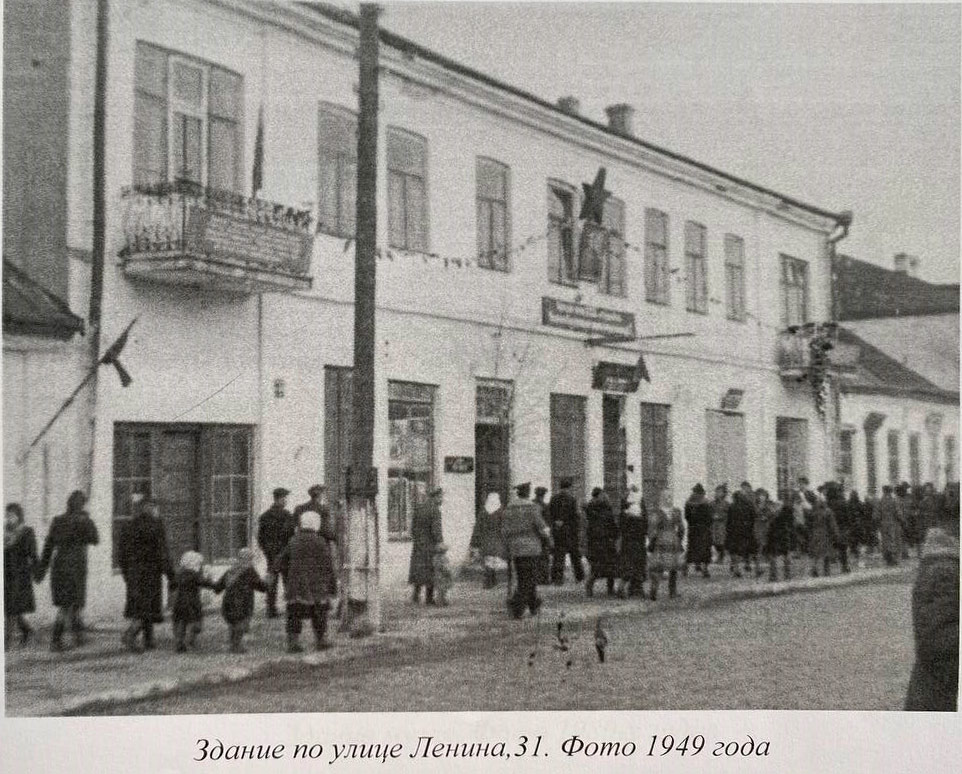
Renovations in the 1950s substantially changed the main façade. A single entrance was retained and, together with two windows, framed by pilasters decorated with faceted squares and a classical cornice. The three windows above the entrance were also given moulded surrounds, with stucco garlands beneath them.
In 1995, the museum moved to the former Jesuit College on Lenina Square.
In 1999, the building was transferred to the Brest branch of the Institute of Radiology, a republican research unitary enterprise under the Ministry for Emergency Situations.
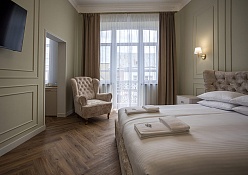
It was not until 2024 that the building returned to its original purpose. Grand Pinsk is more than a hotel: it is a place where history comes to life and every moment becomes part of a distinctive experience.
Welcome to a world of memorable experiences and inspiration.